Unit Conversion
We often need to convert between units of area and volume. When we do this, we need to look out for some common mistakes.
Dimensions
- A length is a dimension
- Area has dimensions of length squared
- Volume has dimensions of length cubed
Units
- Any two lengths is a valid unit of area
- meters squared
- inch-feet
- Any three lengths is a valid unit of volume
- meters cubed
- inch-feet-meters
- An area times a length is also a valid unit of volume
- acre-foot
- We have units of area that don’t use lengths
- acre
- We also have units of volume that don’t use lengths
- liter
- gallon
Intuition
- What is something about the volume of a milliliter?
- What is something about a liter?
- A cubic foot?
- A cubic meter?
It is useful to have a visualization of how linear conversions, area conversions, and volume conversions are related. The Rubik’s Cube is a good visualization.

If we imagine the three-by-three cube side as a yard, we can imagine each block as a foot. Then we see that there are
- 3 feet in a yard
- 9 (3 x 3) square feet in a square yard
- 27 (3 x 3 x 3) cubic feet in a cubic yard
Converting areas
A common source of error is forgetting to apply a linear conversion multiple times to get an area or volume conversion.
1 m^2 = 1 \cdot meter \cdot meter
Here we convert a square meter to square centimeters.
1 \cdot meter \cdot meter \cdot \frac{100cm}{meter} \cdot \frac{100cm}{meter} = 10^4 cm^2
We can also convert from mixed unit areas to other units.
Example: Convert 2 inch-feet to square centimeters
2\; \cancel{\textrm{inch}}\; \cancel{\textrm{foot}} \frac{2.54\; cm}{\cancel{inch}} \frac{30.5\; cm}{\cancel{foot}} = 155\; cm^2
Alternate approach:
By multiplying equations, we can get the unit conversion equation between inch-foot and square centimeters.
1 inch = 2.54 cm 1 foot = 30.48 cm 1\; inch\; foot = 77.4 cm^2
We then multiply by 2 to get the conversion.
2 \cdot 1\; inch\; foot = 77.4 cm^2 \cdot 2
2 \; inch\; foot = 155 cm^2
Converting volumes
Here we show two methods for converting a cubic meter to cubic centimeters.
1 m^3 \cdot \frac{100cm}{m} \cdot \frac{100cm}{m} \cdot \frac{100cm}{m} = 10^6 cm^3 1 m^3 \cdot \left( \frac{100cm}{m} \right)^3 = 1m^3 \cdot \frac{10^6 cm^3}{m^3} = 10^6 cm^3
Alternate approach
Start with the equation
1 meter = 100 cm
multiply the equation by itself three times (cube the equation)
1^3 meter^3 = 100^3 cm^3
1 meter^3 = 1,000,000 cm^3
1 meter^3 = 1 \cdot 10^6 cm^3
We can then use this to convert a quantity:
10 \cdot 1 meter^3 = 1 \cdot 10^6 cm^3 \cdot 10
10 meter^3 = 10^7 cm^3

Converting volumes
- How many cubic inches in a cubic foot?
You can use a unit conversion from
- inches to feet
- from cubic inches to cubic feet
Converting volumes
- Convert cubic meters to gallons
Gallons are not based on a length, so you convert directly.
Estimations using common shapes
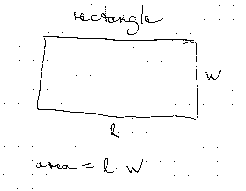
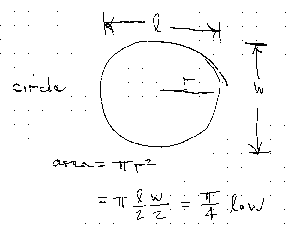
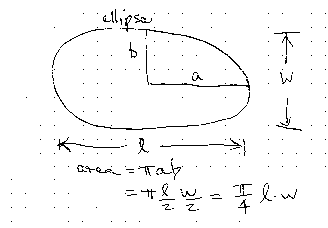
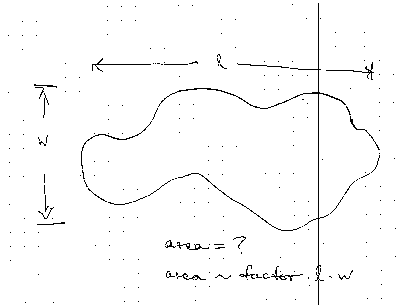
We rarely measure areas directly. For example, there is no tape measure that has an area.
Rectangle
Circle
Ellipse
Any shape
Areas
- Notice that these all involve the length and the width and a factor
| shape | area |
|---|---|
| rectangle | l \cdot w |
| circle | 0.79\ l \cdot w |
| ellipse | 0.79\ l \cdot w |
Area
- Has dimension of length squared
Common Shape Volumes
Basic Volumes
- Cube
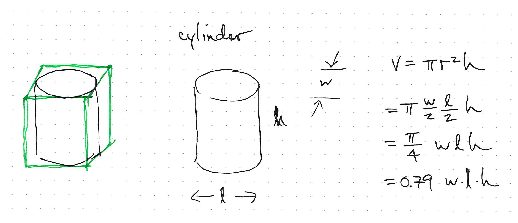
- Cylinder
- Pyramid
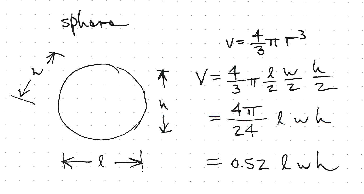
- Sphere
What is in common?
- A length times a length times a length
- Has dimensions of length cubed
- Volume only differs from a rectangular prism by a factor
Cylinder
Sphere
Roots
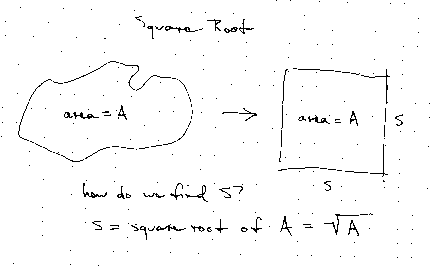
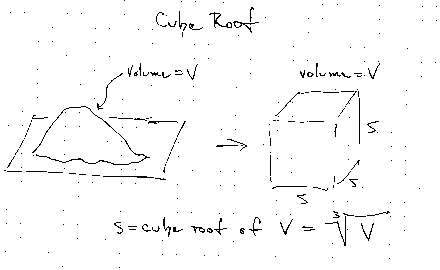
Roots answer the question, what is the size of square or cube that I can fit a given quantity in?
Square roots
- If I have a certain area, how do I find the square that contains that area?
Square Roots
Cube roots
- If I have a volume, how do I find the cube that contains that volume?
Cube Roots
Examples of area models
GPA
The calculation of a grade point average can be thought of as an area problem.
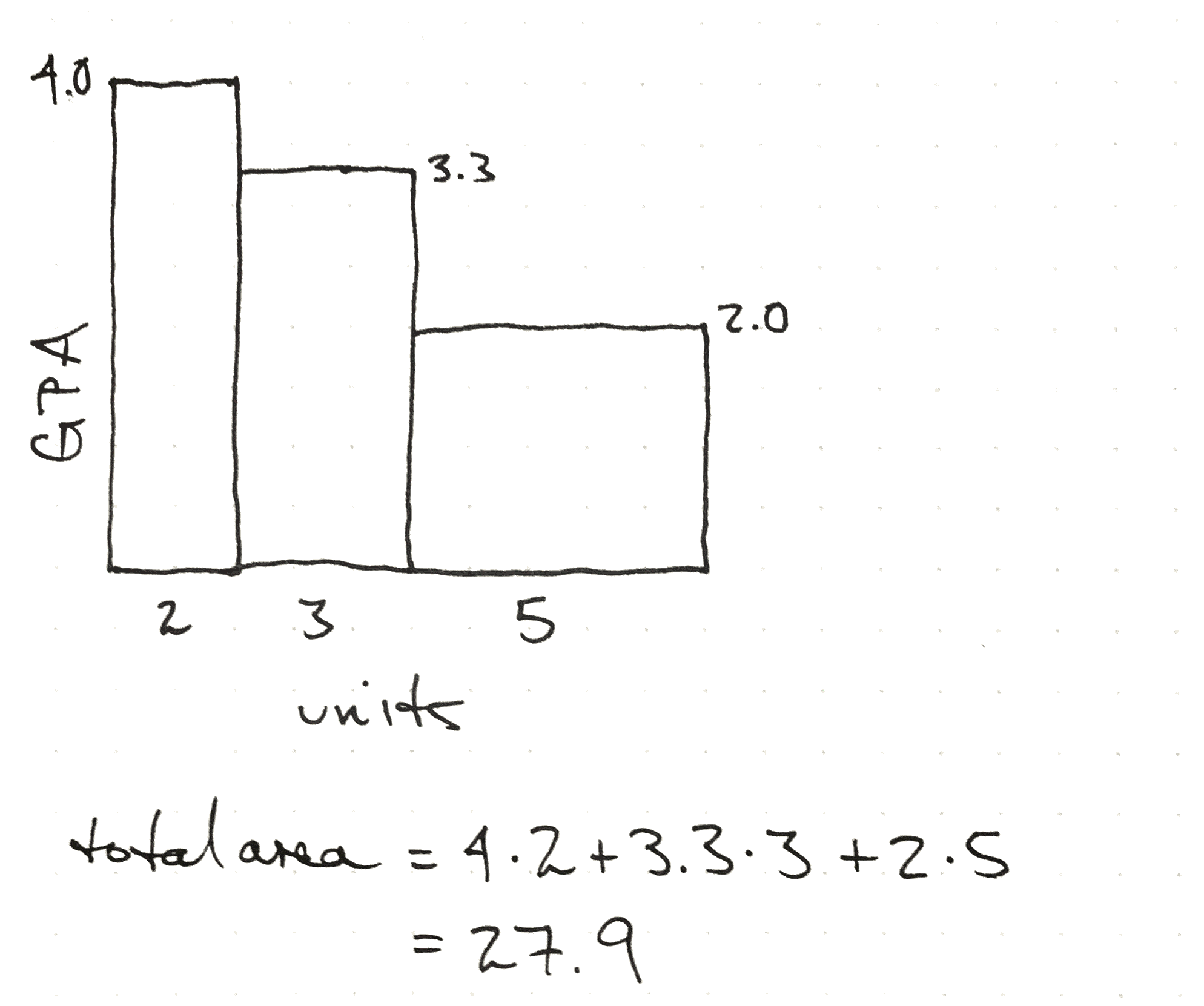
The average is the height of a rectangle that is 10 units long, or 2.79.
Average Power
If we have a power that is changing over time, we can interpret the area under the curve as an energy. The average power is the height of a rectangle with the equal width and area.